Fuel Prices in Hexham: March 2026 Oil Shock Retrospective | We Buy Cars Hexham

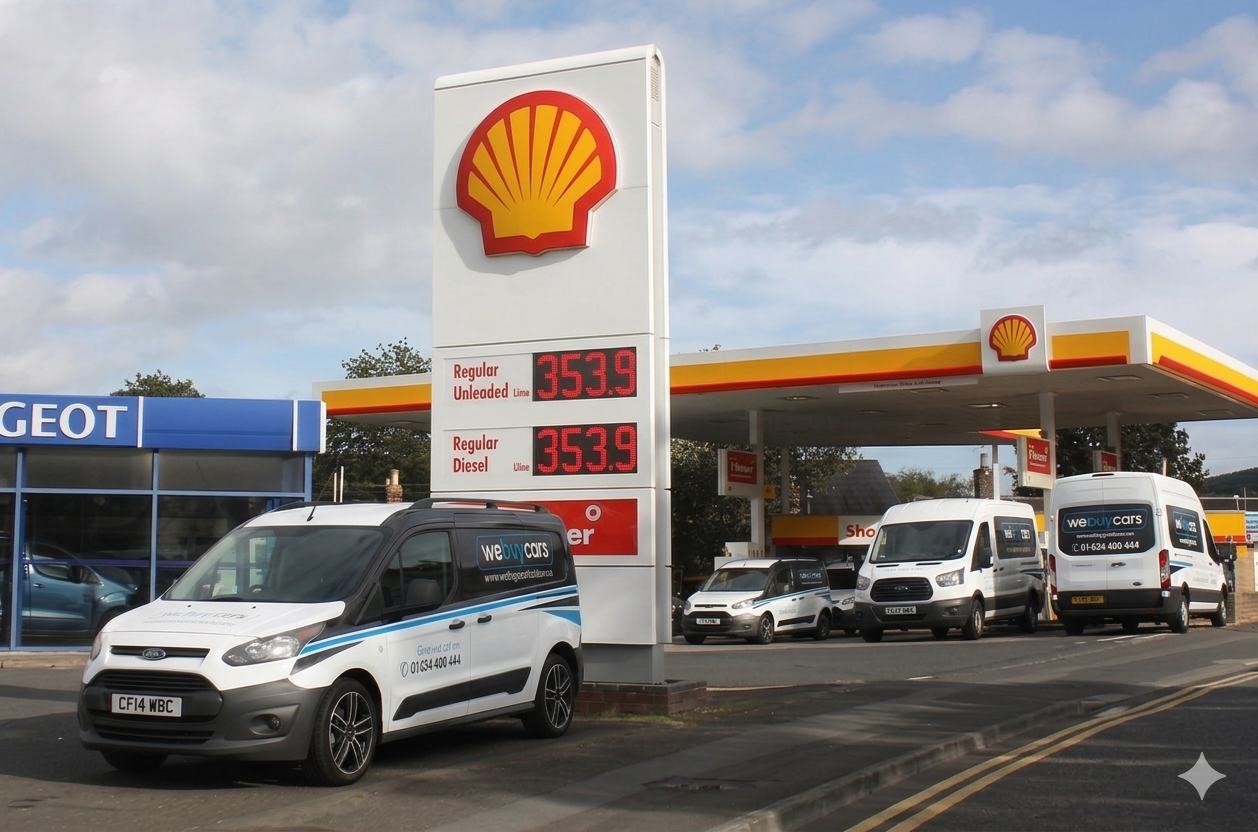
Originally written 20 March 2026 during the Strait of Hormuz oil-price spike. Updated 14 April 2026 to remove specific local forecourt figures that could not be independently verified, and to fold in the data the Competition and Markets Authority published in its December 2025 annual monitoring report. The underlying observation about how rural fuel pricing reacts to a wholesale shock has been preserved.
What was actually happening in March 2026
Late February 2026 brought a major escalation in the Middle East. Strikes on Iranian infrastructure, retaliatory action affecting LNG terminals in Qatar, and a sharp drop in tanker traffic through the Strait of Hormuz - the waterway that carries roughly twenty per cent of the world's seaborne crude oil. Insurance for vessels passing through became impossible to get inside a week. Crude oil crossed the hundred-dollar-a-barrel mark within days and kept climbing.
The knock-on at UK forecourts was the steepest month-on-month pump-price rise since the Ukraine spike of 2022. The RAC's monthly Fuel Watch commentary for March 2026 captured the speed of the move, and the DESNZ weekly road fuel price series recorded the same picture from a different angle. Anyone driving in the Tyne Valley felt it the same week, before the news bulletins had finished writing it up.
What it felt like out here
It is a known thing in the Tyne Valley that pump prices in Hexham tend to sit above the UK average. There is no big supermarket forecourt inside the town competing on price, the nearest competitive options are a drive away, and the local market has fewer sites per driver than Newcastle or Consett. Par for the course - and not unique to Hexham. Most of rural Northumberland sits in the same place, and Northumberland is the least-densely populated county in England, which is the structural reason rather than anything more sinister.
What is more interesting than the headline gap is what the shock revealed about the speed of pass-through. When wholesale prices ran up in early March, the adjustment showed up at local pumps almost the same week. When wholesale prices started coming back off later in the month, the adjustment downward took longer. Rocket up, feather down. That asymmetry is not me making a claim that any individual forecourt is doing anything wrong. It is the regulator's own finding at the UK level, and the spike just made it more visible.
What the regulator says about the bigger picture
On 22 December 2025 the Competition and Markets Authority published its first full annual monitoring report on the UK road fuel market. The headline conclusion (paragraph 15) was blunt:
“This annual report finds that competition in the UK road fuel market has not strengthened since our market study.”
The CMA's market study had been completed in July 2023. The fact that two and a half years later they are saying competition has not strengthened tells you something about the underlying market structure, separate from any individual oil shock. Their numbers are blunt too.
The most telling figure is the retail spread - the slice of your pump price that is not crude oil, refining, fuel duty or VAT. It is the bit that reflects competition at forecourt level. When competition is tight it compresses. When competition is slack it widens. The CMA uses 2015-19 as the baseline because, in their words, "competition worked better" over those years. Here is what the December 2025 report shows for the year to October 2025, alongside the 2015-19 baseline:
| Fuel | 2015-19 average retail spread | Nov 2024 - Oct 2025 average | Above the baseline |
|---|---|---|---|
| Petrol | 6.5p per litre | 13.9p per litre | +7.4p (more than double) |
| Diesel | 8.6p per litre | 14.6p per litre | +6.0p (about 70% above) |
Source: CMA Road Fuel Annual Monitoring Report, December 2025, paragraphs 3.9 and 3.13. The CMA confirms these gaps remain significant even after adjusting for inflation.
The report goes further and says (paragraph summary 3) that operating profit margins for supermarket fuel businesses have roughly doubled between 2020 and 2024. The CMA's interpretation is that rising operating costs - which retailers cite to defend the higher margins - do not fully explain the gap.
What the household maths comes out at
Per-litre figures sound small. They are not, once you multiply them out by a tank and a year. Using the CMA's 7.4p petrol retail-spread excess above the 2015-19 baseline and a typical 50-litre family car tank:
- 7.4p per litre above the competitive-era average
- × 50-litre family car tank = £3.70 extra per fill-up compared with the historic norm
- Weekly fill-up over 52 weeks = £192.40 a year
- Fortnightly fill-up over 26 weeks = £96.20 a year
That is not all retained as profit - the CMA accepts some of it is genuine cost inflation that retailers have absorbed since 2019 - but their analysis says the bulk of it is weakened competition rather than cost pass-through. Either way, the household consequence is the same. The figure above is the floor, before any spike-driven extra movement on top.
What it meant at the buying yard during the spike
Two things were happening at We Buy Cars Hexham through March 2026, and they pulled in opposite directions.
On the private-seller side, valuation enquiries went up noticeably. People with a vehicle they were not heavily using - the second car sitting on the drive, the older daily that had suddenly become uneconomic on a long commute, the thirsty 4x4 that used to make sense and stopped making sense in a week - started asking what their cars were worth. That part of the business held up well. We were buying steadily, and we were paying solid prices for the right stock.
The trade side was a different picture, and it is the bit that took the biggest hit during the spike. We move stock to dealers across the UK and into the Republic of Ireland, and that part of the business depends on vehicle logistics being predictable and reasonably priced. Once fuel costs spiked, vehicle logistics costs spiked with them. Per-mile rates on trade-plate movement drifted upward, per-vehicle ferry and transport rates went the same way, and some of the longer routes started to look uneconomic at short notice. I am not going to put specific pence-per-mile numbers on the moves because they varied per route, per haulier and per week, and the situation was changing fast - but the practical effect was that deals which made commercial sense in February no longer stacked up in mid-March. Some longer-distance trade buyers paused. Some recalibrated. The market for moving used stock around the country slowed.
That kind of squeeze does not last forever. Markets that seize do not stay seized. Once the wholesale shock passed and logistics costs eased back, the trade side recovered. The lesson worth holding onto from the March 2026 spike is the shape of the disruption rather than the exact figures: private enquiries up, trade movement down, with the squeeze felt hardest in the rural areas where there are fewer pump options inside reasonable driving range and where the rocket-and-feather pattern hits harder than it does in Newcastle or Consett.
Why this matters if you are thinking of selling
Running cost is one of the biggest inputs into what a used car is worth on any given day. When pump prices are sticky high and the retail spread is sitting well above its competitive baseline for years at a time - which is the picture the CMA painted in December 2025, before the March 2026 spike sat on top of it - the effect shows up fast in used-car valuations.
- Thirsty cars - V6 and V8 petrols, non-economy diesels, older large 4x4s - soften in the used market as buyers get cautious. Offers come down. Time-to-sell stretches.
- Smaller, more efficient petrols and hybrids firm up at the same time. Demand shifts.
- Rural buyers, who tend to cover more miles a year than the national average, feel all of this faster than metropolitan buyers do. The calculation changes earlier out here.
If running cost is part of why you are weighing up a sale - whether it is a thirsty older diesel, an oversized 4x4 that used to make sense and does not any more, or just a daily driver that has become hard to justify at the pump - we buy across Hexham, Corbridge, Prudhoe, Haltwhistle, Haydon Bridge, Allendale and the wider Tyne Valley. Clean, scruffy, high-miles, non-runner, finance still on it - we will take a proper look and give you a real figure, not an algorithm quote.
Get a free valuation here, or contact the yard if you would rather have a conversation about what your car is worth in today's market.
Sources
- CMA Road Fuel Annual Monitoring Report, December 2025 - retail spread, supermarket vs non-supermarket margins, operating profit findings, and the explicit statement on competition.
- CMA Road Fuel Market Study, July 2023 - the original finding that competition had weakened since 2019, plus the £4.50-a-tank shopping-around figure.
- RAC Fuel Watch - daily UK average pump prices and monthly retailer pass-through commentary.
- DESNZ Weekly Road Fuel Prices - the official UK weekly series, updated every Tuesday, going back to 2003.