2018 Mercedes-Benz A-Class - collected in Gosforth, Newcastle
A probate vehicle collection on a deceased estate in the Gosforth area of Newcastle, referred by a Newcastle probate solicitor firm we work with. A 2018 Mercedes-Benz A-Class, off the road for an extended period, returning a non-start, mouldy interior, heavily corroded diamond-cut alloys and seized brakes at the appraisal stage. Our written probate valuation held for twelve months while grant of probate was obtained. On the eventual collection a hidden gearbox fault surfaced, requiring a winch to the Mercedes main dealer for a substantial four-figure repair before MOT and resale. The estate received the figure on the report; the family did not deal with any of the recovery, repair or resale.
Key info within this case study
- Probate / deceased estate vehicle disposal in Gosforth, Newcastle. Referred by a Newcastle probate solicitor firm we work with as a niche specialist.
- Two specialists, not one. The solicitor handles the estate. We handle the vehicle. Both sides documented to a professional standard.
- 2018 Mercedes-Benz A-Class, silver, hatchback, automatic. Off the road for an extended period prior to inspection.
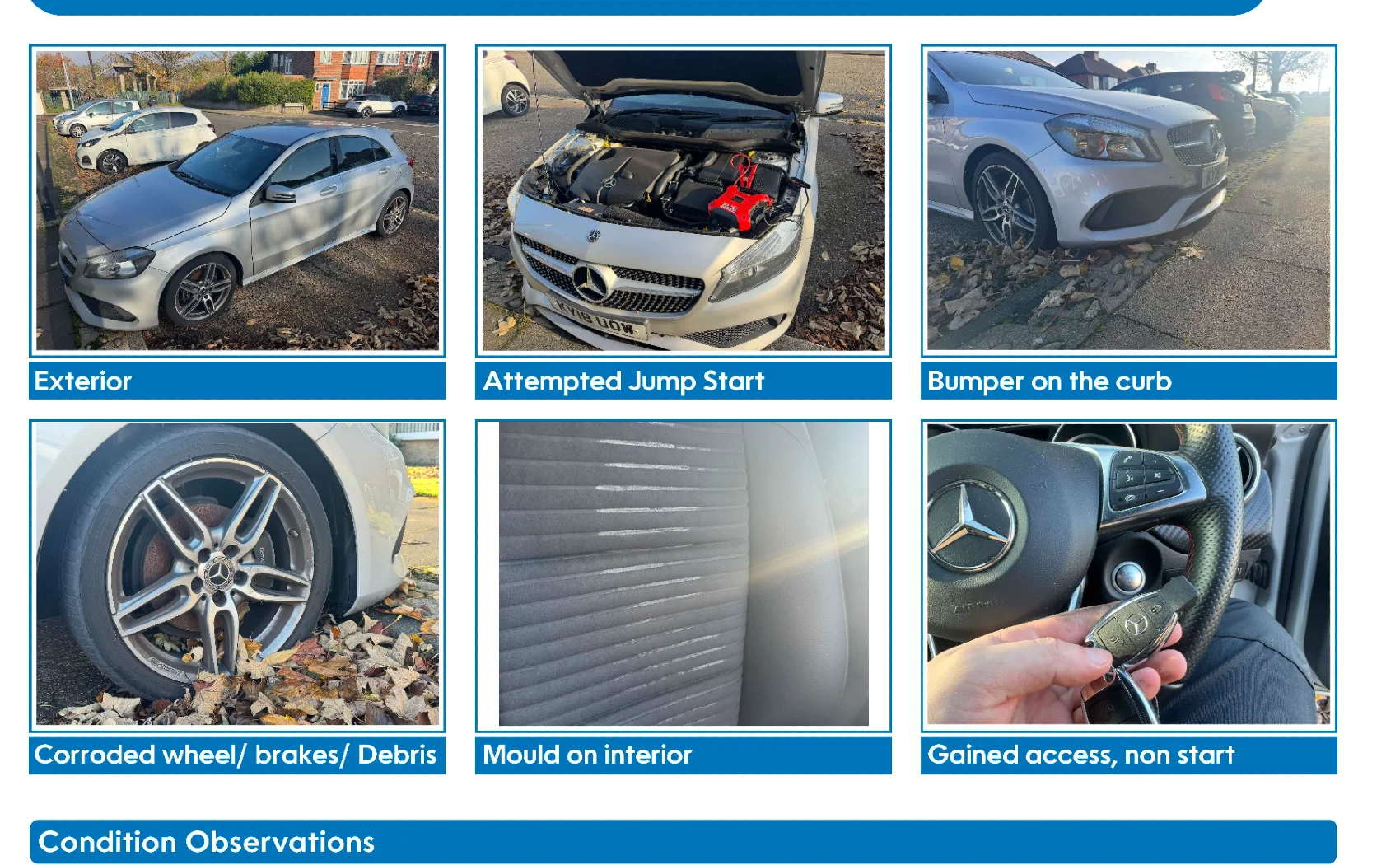
- At appraisal: non-start, flat battery, mouldy interior, heavily corroded diamond-cut alloys, seized brakes, no MOT.
- Written probate-grade valuation valid for twelve months from inspection date, so the offer held while probate was obtained.
- On collection a hidden gearbox fault surfaced. We winched the car to a Mercedes main dealer, paid for the repair, MOT'd it, resold it.
- The estate received the figure on the original report. The family did not deal with any of the recovery, repair or resale.
- Every step of the appraisal and collection is recorded - video walk-around alongside the photographic stills - so the estate has a defensible audit trail of vehicle condition at every stage.
What this case study covers
This is a worked example of how we handle probate vehicle disposal for solicitor firms across Newcastle and the Tyne Valley. The job ran from initial referral through site visit, written valuation, several months of patient hold while probate was obtained, eventual collection, an unwelcome surprise on the day, an off-piste detour through a Mercedes-Benz main dealer, and a final resale. None of it is unusual on a probate vehicle. All of it is what the estate is paying for when they choose a specialist over a national instant-quote tool.
How probate vehicle disposal works in our model
The model is structured. We are not an instant-quote tool that produces a number in twenty seconds and walks away if the figure does not stand up - the WeBuyAnyCar and Motorway-style instant valuation services work very well for ordinary trade-in scenarios but they were never designed for the executor context where the figure has to be defensible to a beneficiary or to HMRC. We are a paid appraisal service that produces a defensible valuation backed by photographic evidence, an HPI check and a written report. The valuation holds for twelve months from the date of inspection. That timeline matters: probate routinely takes six to nine months and can stretch longer. A standard car-buying offer expires inside twenty-four hours.
The fee covers the in-person inspection, the four independent valuation tools we cross-reference against Autotrader's previously-sold transaction data, the photographic record, the video walk-around (we record every appraisal on video alongside the stills, so the estate has a moving-image audit of condition at the point of inspection), and the written report. The valuation we issue is condition-specific, itemised, and defensible against beneficiary challenge or HMRC review. That is the document the estate keeps on file regardless of how the vehicle is eventually disposed of.
The estate then has options on the disposal itself. We offer outright purchase at the documented figure. We offer a market-preparation route where we recover the vehicle, charge the battery, soft-prep mechanical issues, MOT it and take a commission of the eventual sale price. Or we can arrange a documented scrap disposal where the vehicle is too far gone for either route.
The referral and initial site visit
The job came in via a Newcastle probate solicitor firm we work with. They had a 2018 Mercedes-Benz A-Class on a deceased estate in the Gosforth area; the family wanted a defensible valuation for the probate paperwork, with a view to selling once probate was granted. We took the keys and drove to the property.
The first practical question on any probate vehicle is parking position. Council land or private land. Roadside without road tax means a clamping or impound risk if the vehicle is reported, which materially changes the recovery route. This one was on a public road. The MOT had expired and there was no road tax in place; an extended further hold on that pavement was not a sustainable plan and we factored a recovery option into the valuation.
Condition assessment
The vehicle had been stationary long enough for several condition issues to compound.
Access. The keyless fob did not respond on either lower or higher signal settings. We disassembled the fob to expose the manual blade key and used that to open the driver's door. This is straightforward on a Mercedes A-Class of this generation but illustrates the kind of practical step a national instant-quote driver pulling up cold is not equipped to handle.
Battery and electrical. The vehicle battery was completely flat. We attempted a jump-start using our portable power pack on both lower and higher settings. Neither attempt brought the dashboard up or turned the engine over. The diagnosis was a battery requiring replacement plus several days on a slow charger, with an outside chance of additional electrical complications once the body control modules saw normal voltage again.
Bodywork. Acceptable for age. The front bumper had been mounted on a kerb at some point, leaving a small mark but no structural concern. Otherwise the bodywork was in keeping with the year and a deep clean would address most of it.
Interior. Mould had begun forming on the upholstery from the time off the road, particularly on the seat fabric and adjacent door cards. A deep interior clean was costed in.
Wheels. The diamond-cut alloys were heavily corroded across all four wheels. Diamond-cut finishes corrode visibly when moisture ingress reaches the lacquer, and they have to be refurbished off the car at a per-wheel cost. Four corroded wheels is not a marginal cost item.
Brakes. Visual assessment showed brake discs and calipers seized on with rust from the long static period. Not roadworthy in their current state. The likely fix was discs, pads, and at minimum new caliper pins or full caliper replacement depending on how the components freed up under heat and lubrication.
Other risk factors. Leaves had built up around the base of the car, which on a longer hold introduces a risk of rodent damage to wiring (a documented issue on stationary vehicles). Dashboard did not illuminate during the access attempt, which meant we could not pull the digital service history; we treated the vehicle as if no service history existed for the purposes of valuation.
How the probate valuation was built
The headline number on a probate valuation has to be defensible. If a beneficiary disputes the figure, the executor needs to be able to show how it was reached. National instant-quote tools cannot give the estate that evidential standard.
Our valuation methodology runs four independent tools across CAP, Glass's, an autotrader-derived comparable, and a dealer-network buying-tool benchmark, alongside Autotrader's previously-sold transaction data which gives real comparable transactions rather than aspirational asking prices. The four sources are then cross-referenced and a structured Mint, Average, Poor tier is calculated. The final figure is our discretion following the physical inspection, with itemised deductions for each documented issue: per-wheel for the alloys, per-panel for any bodywork, parts-and-labour for the brake work and battery, a non-start factor reflecting the recovery cost, and an additional allowance for the deep interior clean.
The full HPI check ran clean. No outstanding finance markers, no insurance category write-off history, no mileage discrepancies against the DVSA history, no open manufacturer recalls. That part of the report is straightforward but it is the sort of due-diligence layer a national instant car valuation tool, online buying service or trade-desk algorithm tool will not produce on a probate appraisal.
The written report was issued to the solicitor with the photographic evidence record attached. The valuation was valid for twelve months from the date of inspection.
Months later: the collection
The estate sat through the standard probate process. Several months later, with grant of probate obtained, the estate accepted the offer and asked us to collect. We returned to the address with a fresh battery, a slow charger, basic tools and a transporter on standby in case the recovery option needed to be activated.
The fresh battery went in, the engine started cleanly first turn, and the vehicle settled into a normal idle. That part went well. The next test was driving the car onto the transporter under its own power, which would have meant moving the gear selector into Drive.
The selector would not engage Drive. The lever moved through the positions but the transmission did not respond. We tried Park-to-Reverse first, no engagement. Then back to Drive, again no engagement. Switched the engine off and on, no change. Diagnostic tool plugged in, no immediate fault codes that would point to a discrete sensor issue. Some longer-stationary Mercedes A-Class transmissions are known to develop hydraulic seal or solenoid issues from extended hold, particularly when the gear oil has not circulated for many months. This was almost certainly a consequence of the time off the road; not something that was identifiable at the appraisal stage without test-driving the vehicle, which had not been possible on the day of the appraisal because of the flat battery.
The gearbox problem and the Mercedes main dealer route
A non-engaging gearbox on a Mercedes-Benz is not a workshop-floor fix. The seven-speed automatic in the A-Class generation involves manufacturer-specific transmission control logic that benefits from main-dealer diagnostic equipment and main-dealer experience. The right route was to take the car directly to a Mercedes-Benz main dealer.
We winched the car onto the transporter, secured it, and drove it across to the nearest Mercedes-Benz main dealer site. They diagnosed a transmission valve body fault consistent with the long stationary period. The repair was a substantial four-figure cost: the car went on the workshop's main programme, the transmission work was completed under main-dealer warranty on the repair itself, and the vehicle was returned in working order with the gearbox engaging cleanly through all positions.
From there it was a routine retail-prep sequence. Fresh MOT with no advisories of substance, professional valet to address the interior mould, alloy wheel refurbishment off the car, a soft mechanical service. The vehicle came out the other side as a presentable example of a 2018 A-Class, ready to enter our retail and trade pipeline.
Why standing cars develop these problems - and why most dealers will not touch them
The gearbox issue here is a textbook example of why most dealers and most national online buying services will not engage with a vehicle that has been off the road for any meaningful length of time. Cars are not designed to sit. Almost every system on a modern vehicle relies on regular operation to stay functional, and when a car is stationary for months or years a predictable list of issues develops.
Battery. Lead-acid and AGM batteries self-discharge slowly even with no load. With the car's low-current parasitic draw added, a battery left for three to six months will generally be flat. Six to twelve months will often kill the battery permanently. Beyond a year, replacement is almost certain.
Brakes. Cast-iron discs corrode rapidly when not used. Calipers seize when the slider pins are not exercised. Pads bond to discs in damp conditions. A car parked through one wet winter will routinely need a full set of discs, pads and at minimum slider pin work to be roadworthy again. Calipers are sometimes recoverable with heat and lubrication; sometimes they need full replacement.
Tyres. Sidewalls develop flat spots from constant load on the same contact patch. Rubber compounds dry and crack when not flexed. Tyres that look fine visually after a long stand may not be roadworthy under load.
Transmission. Modern automatic gearboxes use hydraulic pressure to engage gears. Seals and valve bodies can stick or fail when the transmission fluid has not circulated for a long period. This is the issue we hit on this collection: the gearbox started, registered electrically, but would not engage Drive because the hydraulic side had seized.
Engine. Cylinder bores can corrode where piston rings are not exercising the surface. Diesel goes stale and bacterial growth in the fuel can clog injectors and the fuel pump (modern UK diesel is biofuel-blended and has a practical shelf life of six to twelve months). Diesel particulate filters become problematic if the regeneration cycle has not run for an extended period; the soot loading can reach a level where active regeneration cannot recover the filter. On a stationary diesel, the cumulative cost of fuel-system flush, DPF cleaning or replacement, and injector work can run into low four figures alone before any other faults are addressed.
Electronics. Body control modules, infotainment systems, and emissions software can develop logical errors when the vehicle has not gone through normal start-up cycles. A diagnostic reset is sometimes required just to get the dashboard to illuminate normally.
Body. Mould develops in the cabin, particularly on fabric seats and headliners. Rodents nest in engine bays and chew wiring, especially on insulated covers and around the air filter. Corrosion accelerates on diamond-cut or non-anodised alloys when moisture sits.
This is the practical cost of buying a stationary vehicle. A national instant-quote tool produces a number based on age and mileage that does not reflect any of this. A standard dealer trade-buying desk runs the registration, sees the gap in MOT history, and walks away. Probate vehicles are routinely affected by these issues because grants of probate take time, during which the vehicle sits. That is exactly why a specialist who actually buys standing vehicles is the practical answer for an estate; a buyer who quotes online and reduces on inspection is not.
This A-Class was just a particularly thorough example. The condition issues were largely visible at appraisal and priced into the offer. The gearbox problem only emerged on collection, after the battery had been replaced and the car returned to operational state. We absorbed that risk because we are set up to absorb it: we have the recovery equipment to move a non-running car, the relationship with main dealers and independent specialists to fix problems beyond a workshop floor, and the retail pipeline to recover value once the car is roadworthy. Most buyers do not have this stack, which is why most buyers will not touch standing vehicles in the first place.
What the estate received
The figure on the original probate appraisal stood. The estate received the documented valuation, the family avoided the entire downstream process of recovering the vehicle, paying for a substantial repair, dealing with MOT and prep, and managing a sale. The probate paperwork closed on the vehicle disposal cleanly, with the report on file as evidence of the figure achieved.
From the solicitor firm's perspective the file was uncomplicated: probate-grade valuation in early, written and on file; estate accepts when probate is granted; vehicle gone within days of acceptance; payment cleared by Faster Payments to the executor account; V5 paperwork handled trade-to-trade with the dealer section returning to the DVLA.
Why this matters for solicitors and executors looking to sell a Mercedes A-Class or any probate vehicle in Newcastle
The administrative friction on a probate vehicle is significant if it is not handled by someone who deals with it routinely. A few of the structural issues:
Tell Us Once and DVLA keeper reinstatement. The government's Tell Us Once service automatically removes the deceased as registered keeper on notification of death. To then sell the vehicle, the keeper has to be reinstated. This requires a headed letter to the DVLA from the solicitor confirming probate status, alongside the dealer section of the V5C (the yellow slip), which releases ownership back to a trader. We process this routinely. Most online buying platforms are not equipped for this paperwork on a probate situation.
The three-month V5 holding requirement. Many online platforms require the seller to have personally held the V5 for at least three months before they will transact. In a probate context that clock often has not started, which rules out those routes entirely or forces a delay the estate may not want. We work trade-to-trade, which removes the restriction.
MOT status. A vehicle that has been off the road on a probate timeline routinely has an expired MOT. Most online buyers will not transact on a non-MOT'd car, or will heavily reduce the offer. We accept non-MOT vehicles and factor the MOT cost into the appraisal, so the estate receives one figure that already reflects the situation.
Beneficiary conflict of interest. Where a family member intends to purchase the vehicle from the estate, an external valuation is essential to demonstrate the estate received fair value. Our written report exists exactly for this scenario and gives the executor an evidenced basis to set the family-purchase price.
Defensible valuation for HMRC. Probate vehicles form part of the deceased's estate for inheritance-tax purposes. A documented valuation from a recognised specialist is a stronger evidential base than a screenshot of a national instant-quote tool, particularly for higher-value or unusual vehicles where the estate's tax position depends on getting the figure right.
If you are a solicitor, executor or beneficiary in Newcastle, Gosforth, Ponteland, Hexham or the wider Tyne Valley dealing with a vehicle on a deceased estate, the route is to get an appraisal in place early. Our bereavement and probate page sets out the process end-to-end. A current valuation from us holds for twelve months from the date of inspection, so there is no urgency to act on the disposal until the estate is ready.
The valuation wizard or a phone call to 01434 400 444 starts the conversation. There is no obligation beyond the initial inspection itself.